For a while, “stress” was the only explanation I had.
And to be fair, increased stress can absolutely impact the body.
So at first, that explanation made sense. At least partly.
But the more I paid attention, the more I realized it wasn’t specific enough. It was too broad. Too blurry. It explained some things, but not the actual pattern.
Because when everything gets labeled as stress, you can miss what the body is really responding to.
When “Stress” Becomes a Catch-All
Changes in stress levels can affect sleep, appetite, digestion, heart rate, pain, and sensory tolerance.
It matters.
But it can also become the explanation people reach for when there isn’t a clearer framework.
And that’s where it gets tricky.
Because if the only lens is stress, then very different symptoms can get grouped together—even when the details are pointing to something more specific.
Noticing that difference was important for me.
Not because stress was irrelevant.
But because it wasn’t the full picture.
A Moment That Made This Clear for Me
Around the time my symptoms were becoming harder to ignore, I had a cancer scare.
Thankfully, it wasn’t cancer.
But about a month later, my symptoms noticeably increased.
My medical team understandably focused on that timeline and interpreted the shift as a response to the intensity of that experience.
And to be fair—that kind of experience can absolutely affect the body.
I believed my team that this may have been contributing to what I was experiencing. And at the same time, I also believed there was a physical and medical explanation—something that had been present long before and likely predisposed me to the flare I was in.
Because when I looked more closely, some of my symptoms had been there for years.
What I Had Been Noticing All Along
I had photos going back six years—starting after my pregnancy with my daughter—of my face becoming flushed and red.
At the time, I didn’t know what it was.
But something about it felt unusual enough that I kept documenting it.
I didn’t have an explanation for it yet.
I just knew it was happening consistently enough that I kept noticing.
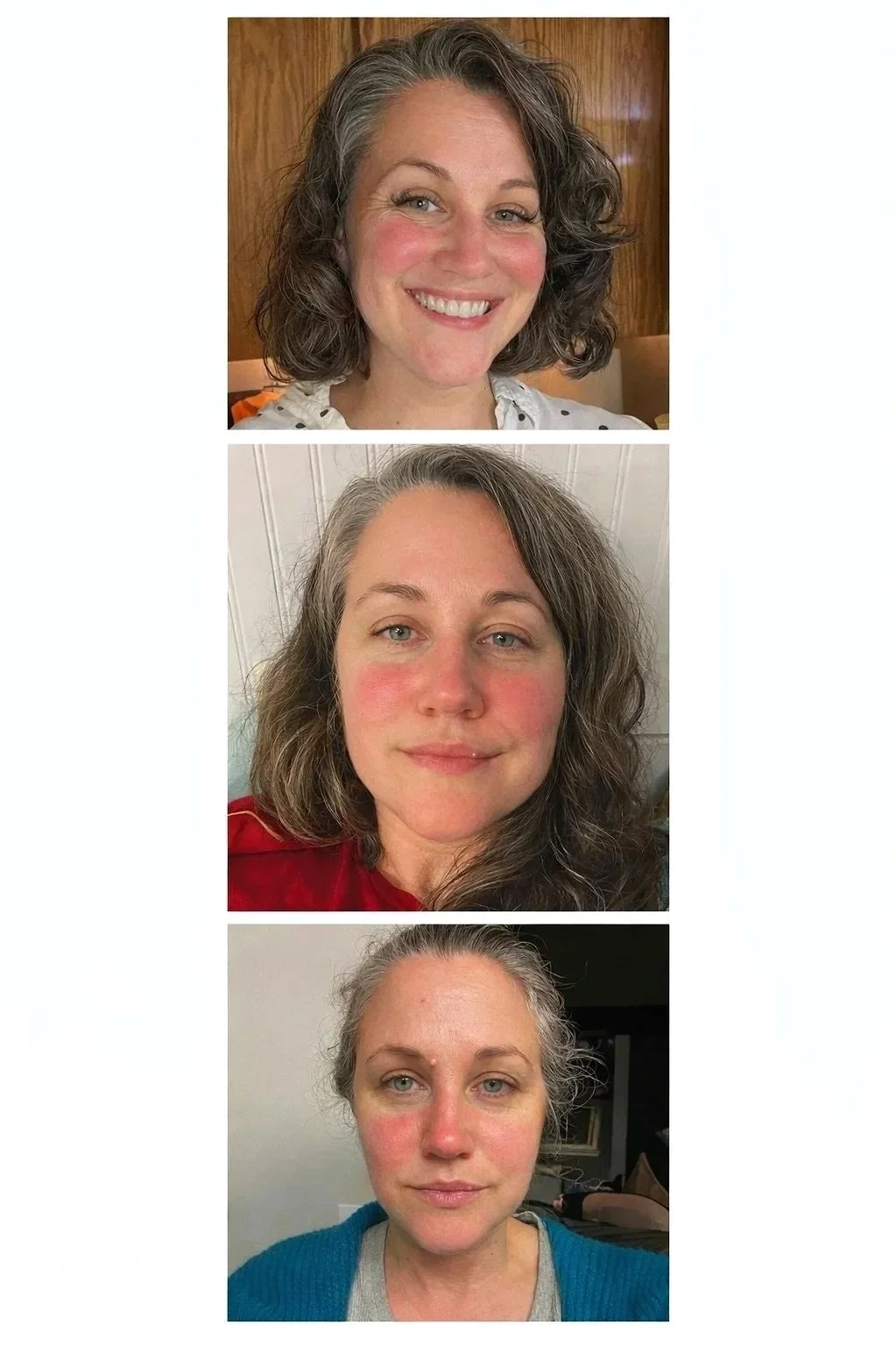
These are a few examples I had documented over the years (2021, 2023, 2024) and at the time, I didn’t know what they meant.
I just knew they felt consistent enough to keep tracking.
Same Face. Different moments. Not anxiety- my body responding.
Early on the flushing was milder and harder to capture.
Sun and heat exposure were a primary trigger even with sunscreen and cooling measures (this wasn’t just overheating and it wasn’t a sunburn).
During the height of my health flare this was usual for me by the end of every day including the left eye ptosis (droopy eyelid) accompanied by extreme fatigue and headaches.
Looking back, documenting years of this symptom gave me something concrete to bring into appointments—and helped me build a clearer case with my Rheumatologist that this wasn’t fully explained by stress or the timing of the cancer scare.
What I Was Actually Experiencing
What had once been occasional became daily.
The flushing wasn’t random.
It showed up:
at the end of the day when my body was fatigued
with sensory overwhelm
with headaches
after eating
even with something as specific as headlights at night while driving—which at times made driving feel almost impossible
And once I started looking at those patterns, it became harder to explain everything through a single lens.
What I Started Noticing Instead
Once I shifted away from only asking, “Is this stress-related?” I started asking a different question:
What happened right before this?
And slowly, other patterns started to stand out.
Things like:
food
light
sound
movement (shifting from laying down/sitting to stand up or exercise)
position (looking down at work with my neck bent forward was a huge trigger for me and continues to be one of my biggest symptom triggers)
environment
sensory load
how much my body had already been managing that day
Not always in a neat, predictable way.
And that was part of what made it so confusing.
The Part That Made Me Question Myself
Sometimes I would react to something one day and not the next.
A food. A space. A level of activity.
And that inconsistency made it really easy to doubt myself.
It created that familiar loop:
“Maybe I’m overthinking this.”
“Maybe this doesn’t mean anything.”
“Maybe if it were real, it would happen the same way every time.”
But bodies are not machines.
And complex symptom patterns rarely behave in perfectly tidy ways.
Sometimes what looks inconsistent is actually layered.
The trigger may not just be the thing.
It may be the thing plus:
timing
total load
nervous system state
sensory input
how depleted the body already is
That doesn’t make it imaginary.
It makes it more complex.
Triggers Are Not Always Obvious
One of the most frustrating parts of this process is that triggers are often not dramatic.
They can be subtle.
A bright store. A loud room. A delayed meal. Standing too long. A certain kind of movement. A food that is fine one day but not fine on another.
And because many of these things are so ordinary, they’re easy to overlook.

Grocery stores are a really common example.
The combination of:
bright fluorescent lighting
constant background noise
cleaning products and scents
visual and sensory load
can be a significant trigger for sensitive nervous systems—especially for those of us with neurodivergence and hypermobility.
It’s also one of the most common environments where people describe having what feels like a panic response.
Looking back, I realized I had already adapted to this without fully understanding why.
After Covid, I never went back to grocery shopping in person. I continued ordering groceries and having them picked up.
At the time, it just felt easier.
Now I understand that my body had already learned something important—it was responding to environments that were overwhelming in ways I didn’t yet have language for.
I hear similar patterns from many of the young clients I work with.
Malls and grocery stores are often some of the first environments they identify as distressing.
For some, these reactions go back years—long before anyone connected it to sensory processing, nervous system sensitivity, or underlying medical patterns.
But when we start looking at these environments differently—not as something to “push through,” but as places with specific sensory and physiological demands—the reactions begin to make more sense.
What Helped Me Most
What helped was not trying to solve everything at once.
It was getting more specific.
Instead of:
“What’s wrong?”
I started asking:
What happened before this?
What else was going on today?
Was my body already overloaded?
Is this happening in certain environments?
Is this worse after eating, after movement, after sensory input, after pushing through?
That shift didn’t give me instant answers.
But it gave me better data.
And better questions.
This Isn’t About Becoming Hypervigilant
This is not about obsessively monitoring every sensation.
It’s not about becoming more overwhelmed.
It’s about noticing patterns with a little more accuracy and a little less self-doubt.
Sometimes Internal State Is Part of the Picture—Just Not All of It
Internal states can lower your threshold.
They can make symptoms more likely, more intense, or harder to recover from.
But that doesn’t mean they explain everything.
Sometimes they are part of the picture.
But they are not the whole picture.
A More Helpful Question
Instead of asking:
“Is this just stress?”
A more helpful question might be:
“What combination of things is this body responding to right now?”
If This Feels Familiar
If you’ve been trying to understand symptoms that seem inconsistent, vague, or hard to explain, you’re not doing it wrong.
And you’re not failing because the answer hasn’t been obvious yet.
Sometimes the pattern is there.
It just takes time, curiosity, and the right lens to start seeing it.
What Comes Next
In the next post #4 of this series, we’ll look at another question that helped clarify things:
What happens after you push through?
Because for a lot of people, that’s when the body starts getting louder.
If you missed the earlier posts in this series:
Read #1 : When Your Labs Are “Fine”… But You Don’t Feel Fine
Read #2 : Do My Symptoms Follow My Thoughts… or Show Up on Their Own?
If You’re Not Sure Where to Start
Support, if you want it
If you’re looking for more personalized support in making sense of symptoms—for yourself or your child—you don’t have to navigate this alone.